Stop Optimizing Real Estate Ads on Leads. Start Optimizing on Closed Deals.
By Rajesh Kumar, Founder, Attribi · · Updated
If you run paid ads for a real estate business, you already know the pattern. You pour budget into Google and Meta, the leads come in, and the platforms happily report a low cost per lead. Then you look at what actually closed, the enquiries that became viewings and the viewings that became signed deals, and the picture falls apart. The campaigns with the cheapest leads are rarely the ones producing commission.
The gap has a structural cause: Google and Meta can only optimize toward what they can see, and they cannot see your CRM.
A lead fills in a form, and days or weeks later it closes offline, over a call, at a site visit, inside your CRM. The platforms never find out. So they keep optimizing toward cheap form-fills instead of closed deals.
Offline conversion tracking is how you close that gap. This guide explains what it is, why real estate lead attribution breaks without it, and how to move your campaigns from optimizing on raw leads to optimizing on real CRM events, the qualified leads and closed deals that actually signal revenue.
What is offline conversion tracking?
Offline conversion tracking is the process of recording conversions that happen after someone leaves your website, such as a qualified lead, a booked viewing, or a closed deal in your CRM, and sending them back to your ad platforms. It lets Google, Meta, and others optimize bidding toward real revenue instead of raw form submissions.
The word "offline" is slightly misleading. It does not only mean phone calls or in-person meetings. It means any conversion that happens outside the ad platform's line of sight, which, for real estate, is almost every meaningful one. The enquiry is online. The decision that matters is not.
Online vs. offline conversions
An online conversion is something the ad platform can observe directly: a form submission, a button click, a page view. It fires a pixel and attributes it to a click.
An offline conversion happens later, somewhere the pixel cannot reach. The lead is qualified by your sales team, books a viewing, or signs. To attribute it, you have to tell the platform it happened, and tell it which click it came from.
How it works, end to end
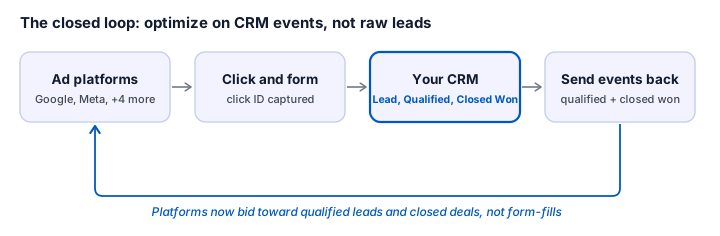
Offline conversion tracking connects the click to the close in three steps:
- Capture the click ID at lead capture. When someone clicks your ad and submits a form, the ad platform's click identifier (Google's GCLID, Meta's fbclid) is captured and stored alongside the lead in your CRM.
- Record the outcome in your CRM. Your team works the lead as normal. When it becomes a qualified opportunity or a closed deal, that status lives in the CRM.
- Send the outcome back to the ad platform. The closed deal, tied to its original click ID, is uploaded back to Google, Meta, or wherever the click came from, so the platform learns which ad produced revenue.
That round trip is the whole game. Once it is running, the platforms can optimize toward the outcomes you actually care about. Attribi runs this round trip for you, from click ID capture to the conversion upload, and you can try Attribi free for 30 days on the Pro plan, with no card required.
Why real estate lead attribution breaks without it
Real estate is close to a worst case for last-click attribution. The reasons are structural, not something better reporting alone can fix.
The sales cycle is long and offline
A real estate enquiry rarely closes the same day, or even the same month. The cycle runs long, routinely well beyond 90 days, through a call, a qualification step, one or more viewings, negotiation, and finally a signature. Every step that matters happens where the pixel is not.
Lead-form data hides the truth
Optimize toward form-fills and you optimize toward volume, not quality. A campaign can produce a flood of cheap leads that never qualify, while a more expensive campaign quietly produces the deals that pay the bills. On a cost-per-lead dashboard, the first one looks like the winner. On a cost-per-closed-deal basis, it is often the opposite.
Without offline conversion tracking, you are not just missing data. You are actively training your ad platforms to spend more on the wrong leads. If you are not sure whether that is already happening in your account, there is a three-question test for whether your ads are optimizing on the wrong conversions.
How offline conversion tracking fixes it: the closed loop
The fix is to give the ad platforms the one thing they are missing, the outcome, and connect it back to the click that started it.
Capturing the click ID (GCLID, fbclid)
Click ID capture starts at the form: the ID has to be captured the moment the lead is created and stored with that lead in your CRM. If it is not captured, there is nothing to match the eventual close back to, so this step is non-negotiable.
It is also where a lot of home-grown setups quietly fail. The ID never makes it into the CRM, and the loop cannot be closed later.
Sending outcomes back via the Conversions API
Once a lead closes, that outcome, with its click ID, goes back to the platform through its conversion API. For Google that is offline conversion import and, for lead forms, enhanced conversions for leads. For Meta it is the Conversions API. Server-side uploads like these are also more durable than browser pixels, which get blocked or dropped.
Seeing the full journey, not just the last click
Closing the loop on a single platform is a start. But a real estate buyer might click a Google search ad, later see a Meta retargeting ad, and come back through a third touch before they convert. Multi-touch attribution credits each of those touches across the journey instead of handing all the credit to whatever came last. That is the difference between knowing a deal closed and knowing what actually drove it.
Closed deals are too few to optimize on. Use your mid-funnel CRM signals.
Here is the trap most "send your closed deals back to Google" advice walks straight into. In real estate, closed deals are high value but low volume. You might close a handful a month. Ad-platform bidding algorithms, like Google Smart Bidding and Meta's optimization, need a steady volume of conversions to learn from. Feed them three or four closes a month and they have almost nothing to work with.
The volume you need is already sitting in your CRM, one stage earlier.
Not every lead is a real buyer
A real estate lead form catches everyone. Genuine buyers, yes, but also broker leads, job-seeker leads, and service-provider leads who will never purchase a property. Optimize on raw form-fills and you are effectively paying Google to find you more brokers and job-seekers.
So the goal is not "more leads," and it is not "wait for closes." It is to identify the leads that are real and steer spend toward those.
The lead-quality ladder
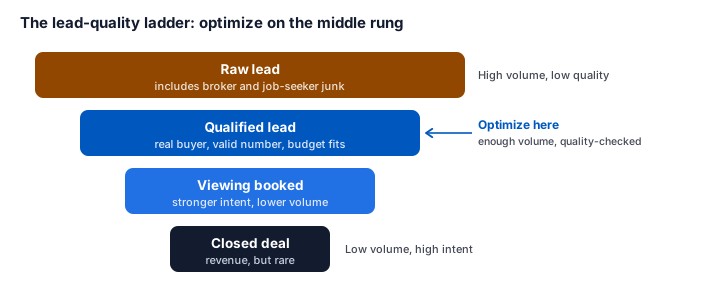
Think of your funnel as a ladder of signals. Each rung has less volume but more intent:
- Raw lead. Anyone who submitted the form, junk included (brokers, job-seekers, service providers). High volume, low quality.
- Qualified lead. A real prospective buyer with a valid, reachable mobile number, genuine intent to buy, and a budget that fits. Enough volume to optimize on, and quality-filtered.
- Viewing or site visit booked. Stronger intent, lower volume.
- Closed deal. The outcome and the revenue, but too rare to bid on directly.
Optimize on the middle of the ladder
Instead of sending only closed deals, send the mid-funnel signals, your qualified leads and booked viewings, back to your ad platforms as conversions. They carry enough volume to actually move bidding, and because they have been quality-checked in your CRM, they push spend toward real buyers and away from the junk. You still send closed deals too, as the revenue signal on top, but the mid-funnel signals are what let the algorithm learn fast.
This is the practical bridge between raw leads, which are too noisy, and closed deals, which are too rare. Use the qualitative signals your CRM already captures as the optimization target. Attribi is built to send these mid-funnel CRM signals back across every platform, not just the final sale. If this is the gap in your setup, you can connect your CRM and see which campaigns produce qualified buyers rather than junk.
Offline conversion tracking across your ad platforms
Most real estate advertisers do not run one platform. They run several, and the closed-loop problem exists on every one of them. Here is how the major platforms handle offline conversions.
Google Ads
Google supports offline conversion import, which uploads closed deals against their GCLID, and enhanced conversions for leads, which matches CRM outcomes back to ad clicks using the lead's information. Both let Smart Bidding optimize toward qualified or closed leads rather than raw form-fills. Google reports that advertisers who pair first-party data with GCLID offline imports, which is what enhanced conversions for leads does, see a median 10% increase in recorded conversions over standard offline import (Google Ads Help). Enhanced conversions for leads also helps recover conversions that cookie restrictions and iOS App Tracking Transparency would otherwise hide.
If Salesforce is your CRM, both routes are covered step by step in Import Salesforce Closed-Won Deals into Google Ads, including the two setup paths Google retired in 2025 and 2026.
Meta (Facebook and Instagram)
Meta's Conversions API sends server-side events, including offline and CRM outcomes, back to Meta, so campaign optimization and reporting reflect deals and not just leads. Meta's own studies report that CAPI can drive up to 19% more attributed events, up to 13% lower cost per result, and a 44% increase in the rate of turning a lead into a quality lead (Meta studies, via Supermetrics).
If Salesforce is your CRM, Send Salesforce Closed-Won Deals Back to Meta Ads walks through the Conversions API setup, including which identifier to send and why a successful upload can still match nobody.
LinkedIn, Microsoft, TikTok, and Snapchat
Each of the other major platforms has its own conversion API for sending back offline events. The practical challenge is not any single one. It is wiring up all of them, keeping the click IDs matched, and maintaining every connection as the platforms change.
This is where Attribi fits. It runs offline conversion tracking across all six platforms, Google, Meta, LinkedIn, Microsoft, TikTok, and Snapchat, from one place, so you are not stitching together six separate integrations and babysitting each one.
Connecting your CRM
Offline conversion tracking is only as good as its connection to where your deals actually close, your CRM. Attribi integrates with Salesforce, HubSpot, and LeadSquared, the CRMs real estate teams actually run. Salesforce is the backbone for many Dubai and UAE brokerages, and LeadSquared is purpose-built for the high-volume lead management that real estate marketing generates.
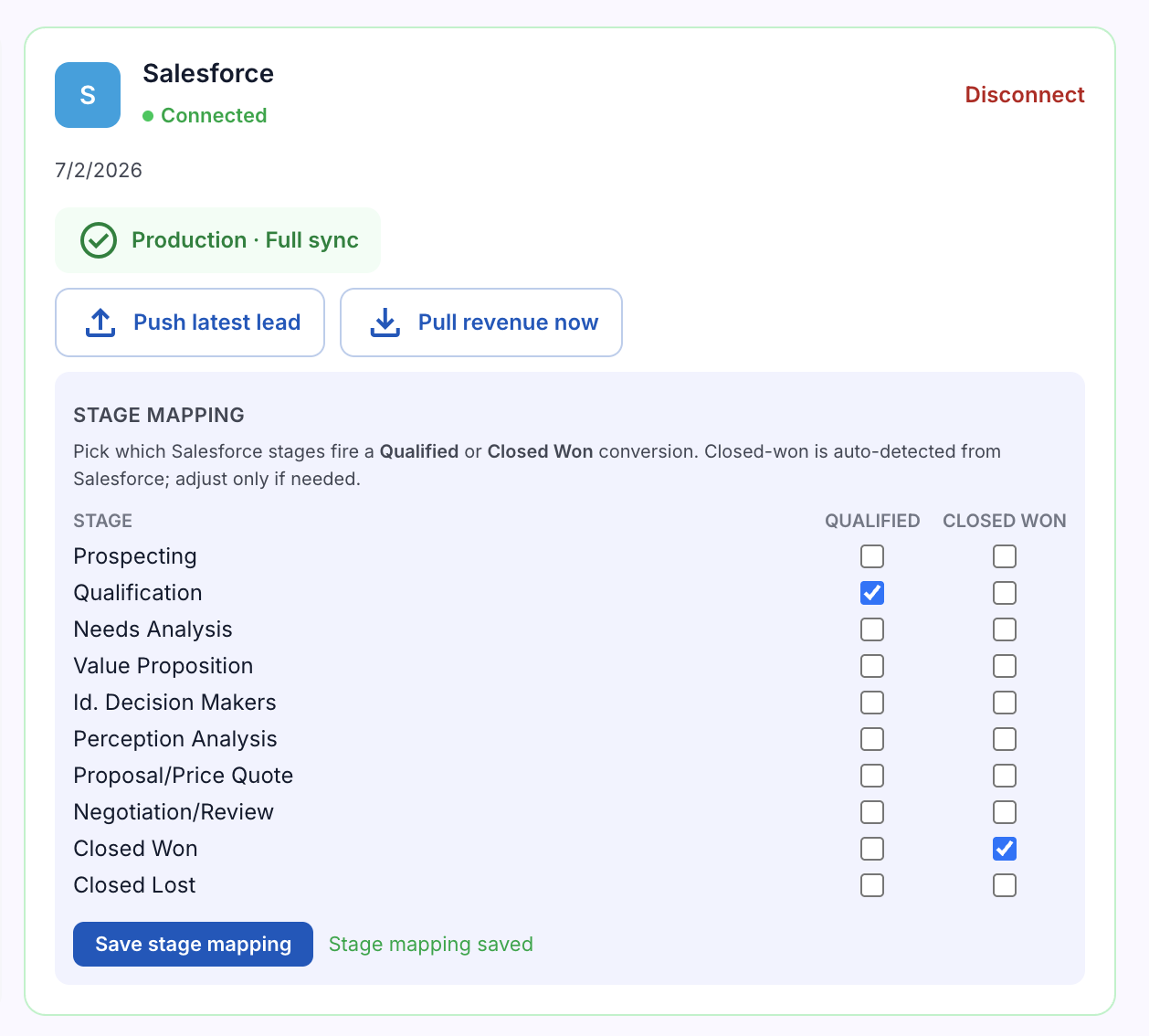
The CRM is the source of truth for what "closed" means, and that is exactly what Attribi's Salesforce integration is built around. You map which of your pipeline stages count as a qualified lead and which count as closed won, right down to the stage names you already use. Closed won is auto-detected from Salesforce, so most teams do not need to configure it by hand. From there, Attribi reads those outcomes and feeds them back to the right ad platform, matched to the originating ad and campaign, automatically and on an ongoing basis, so you are not exporting spreadsheets and uploading conversions by hand every week.
What changes when you optimize on CRM events instead of leads
Once the loop between your CRM and your ad platforms is closed, three things change in how you run paid:
- Bidding optimizes toward revenue. Smart Bidding and Meta's optimization start steering budget toward the audiences and keywords that produce qualified leads and closed deals, not the ones that produce the most forms.
- Your reporting finally matches reality. Cost per qualified lead and cost per closed deal replace cost per lead as the numbers you manage to, and the "cheap" campaigns that never closed stop looking like winners.
- You can defend the budget. When finance asks what the ad spend returned, you have the answer in the same terms they think in: qualified pipeline and revenue, traced back to the campaigns that drove them.
For the arithmetic behind those numbers, and why the inputs matter more than the formula, see how to measure ROI on paid leads that close in the CRM.
That is the shift in one line. Stop optimizing on raw leads. Start optimizing on qualified buyers and closed deals. Attribi is built to make that shift the default. It closes the loop between ad spend and closed deals across every platform you run.
FAQ
What is offline conversion tracking? It is recording conversions that happen after someone leaves your site, such as a qualified lead or closed deal in your CRM, and sending them back to your ad platforms so they can optimize toward revenue instead of form-fills.
How do you track offline conversions in Google Ads? By capturing the GCLID when a lead is created, storing it in your CRM, and uploading the closed outcome back to Google via offline conversion import or enhanced conversions for leads.
What is lead attribution in real estate? It is connecting each closed property deal back to the specific ad, campaign, and channel that originally produced the enquiry, across a sales cycle that mostly happens offline.
How do real estate companies know which ads generate closed deals? By closing the loop: capturing the click ID at enquiry, tracking the deal to close in the CRM, and feeding that outcome back to the ad platforms so each closed deal is tied to its source ad.
Can you send CRM data back to Google and Meta? Yes, through Google's offline conversion import and enhanced conversions for leads, and Meta's Conversions API. Attribi automates this across all six major ad platforms.
What are enhanced conversions for leads? A Google Ads feature that matches CRM-recorded lead outcomes back to the original ad click using the lead's information, so bidding can optimize toward qualified and closed leads.
Should I optimize my ads on closed deals or qualified leads? In real estate, closed deals are usually too few to train ad-platform bidding. Optimize on a higher-volume mid-funnel signal, a qualified lead (real buyer, valid number, genuine intent, budget fit) or a booked viewing, and send closed deals on top as the revenue signal.
Start optimizing on what actually closes
Your real estate campaigns are only as smart as the outcomes you feed them. Give them qualified buyers and closed deals instead of raw leads, and they will start spending where the commission is.
Attribi closes the loop between ad spend and closed deals across Google, Meta, LinkedIn, Microsoft, TikTok, and Snapchat, connected natively to Salesforce, HubSpot, and LeadSquared.
The fastest way to see it on your own pipeline is to start your free trial. It runs for 30 days on the Pro plan, with no card required.