How ad platforms count and report conversions differently
By Rajesh Kumar, Founder, Attribi ·

Your Google Ads dashboard says 120 conversions. Meta Ads Manager says 90. The CRM shows 14 closed deals. You lean back and wait for the "which number is real" question from your boss.
That question is the wrong one. The right question is simpler and immediately more useful: what is each number telling you? The disagreement isn't a bug; it's a direct result of how ad platforms count conversions differently. You don't need the platforms to agree. You need to read each report for the slice of the journey it shows, then anchor everything to the CRM as your source of closed-deal truth.
Why the same campaign produces different conversion numbers
Attribution is the method an ad platform uses to decide how much credit a conversion gets. Platforms use different attribution models and conversion windows, so the same lead can be counted differently. Each report is true from that platform's vantage point, but none alone is the full picture.
What looks like a mismatch across dashboards is actually three independent counting mechanisms working at the same time. Each one answers a different question, which is exactly what makes the divergence useful. Connect your CRM and start tracking closed-loop ROI free.
The attribution model decides who gets credit
First-touch attribution gives full credit to the first ad a user clicked. Last-touch (still the default in many reports) gives it all to the last click before the form fill. Linear splits credit equally across every touch. U-shaped gives more weight to first and last, with smaller shares for the middle. Data-driven attribution uses actual conversion data to assign weights algorithmically. Attribi offers all five models, but the platforms themselves set different defaults, so the same lead can be credited to completely different campaigns depending on which model you're reading.
The conversion window decides when to count
Every platform draws a time boundary around a conversion. Click-through conversions count when someone clicks an ad and converts within a set number of days. View-through conversions count when someone sees an ad, does not click, but converts later. The window lengths differ by platform. If you don't align the windows mentally, you're comparing a 30-day view-through count on one platform with a 7-day click-through count on another, and the gap looks like a failure when it is just two different measurement rules.
Every platform has blind spots
An ad platform can only count what it sees. Phone calls, WhatsApp chats, in-person visits, cross-device browsing, and the offline CRM close happen far outside any platform's view. When a qualified lead turns into a closed deal inside Salesforce, that conversion never reaches Google or Meta unless you push it there yourself. Each platform's reported number is missing every conversion that happens after the digital trail goes cold, which is most high-value closed deals in real estate lead generation.
What each platform's number is actually telling you
Platform metrics are not universal truths. They are platform-specific counts that answer a single question: how many conversions did this platform choose to credit itself for, using its own model and its own window?
Google Ads
Google's conversion count answers the question: "How many conversions did Google's reporting system decide were driven by Google Ads?" It leans heavily on its own data-driven attribution where available, or falls back to last-click. Treat the number as a directional upper bound, not a confirmation of closed revenue.
Meta
Meta's number answers: "How many people did Meta think it influenced?" It tends to count view-through conversions more aggressively and uses shorter default windows. A conversion that is merely viewed-and-not-clicked still lands in the report. Read the Meta number as an influence estimate, not a closed-deal count.
LinkedIn, Microsoft, TikTok, Snapchat
Each of these platforms reports its own view of success: platform-centric, self-credited, and blind to what happens in your CRM. Their reports are most useful for relative comparisons inside the same platform. Did the cost-per-lead trend improve compared to last month? That comparison works. Using the absolute number as a universal truth across platforms does not.
Across all six ad platforms Attribi tracks, the reporting gap is identical in shape. The divergence is not a sign your setup is broken. It is the natural output of six different measurement systems each answering the question that makes its own performance look most coherent.
The gap between claimed conversions and closed deals is the signal
The truth gap: platform claims versus CRM verification
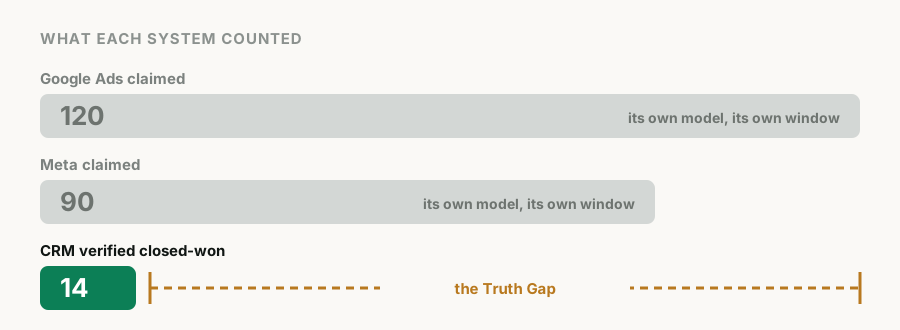
When you compare platform-claimed conversions with the deals your CRM actually marks as closed-won, you get a number that matters more than any dashboard figure. Attribi's Truth Gap does exactly this: it lays platform-claimed conversions side by side with CRM-verified closed deals so you can see the difference. That difference is not a failure; it's a visibility gap you can close.
When disagreement tells you something useful
You don't need the platforms to agree. You need to read relative trends. If Google's claimed conversions are trending down while Meta's are flat, that shift is still readable and actionable. If every platform's cost-per-lead moves the same direction, the signal is reliable even if the absolute counts differ. Agreement across platforms was never the goal. The goal is having a CRM-verified outcome that you can feed back to every platform as the shared source of truth. Start your free trial.
How to use the disagreement instead of fighting it
Read each number for direction, not truth
Compare like with like. Track Google's reported conversions against Google's own previous numbers. Do the same for Meta, LinkedIn, and the rest. Use trend lines, not isolated snapshots. Never mix attribution models or conversion windows when judging a change, or you'll see a phantom rise or drop that is just a measurement artifact.
Send CRM outcomes back to the platforms as offline conversions
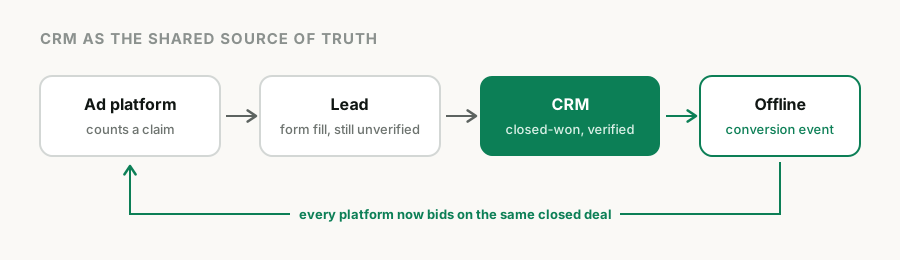
The fix for the reporting gap is not making the platforms agree. The fix is giving each platform the same truth. When a lead closes in your CRM, that outcome is matched to the originating ad and sent back to the ad platform as an offline conversion. Every platform then optimizes against the same closed-deal signal, not against its own self-credited form fills. The CRM becomes the shared source of truth, and the "wrong" numbers become irrelevant because you're bidding on real revenue.
Optimize toward qualified leads and closed deals, not form fills
Raw form fills hide broker leads, job-seeker leads, service-provider leads, and every other type of junk that fills a real estate form. When you feed CRM outcomes back to the platforms, you teach them to optimize toward qualified leads and closed deals, not toward more forms. The platform still reports its own conversion number, but that number now reflects the downstream outcome that actually pays the bills. The disagreement between platforms doesn't disappear, but it stops mattering.
FAQ
Why do Google Ads and Meta report different numbers for the same campaign?
They use different attribution models, different conversion windows, and different rules for how view-through conversions are counted. Each platform answers the question "how many conversions did our system think we influenced" using its own methodology.
Which platform's conversion count is correct?
None of them is a complete picture of revenue. Each is correct within its own measurement rules, but all of them miss what happens offline in your CRM. The CRM-verified closed deal is the only count that reflects revenue.
What is the difference between click-through and view-through conversions?
A click-through conversion requires a click on the ad before the form fill. A view-through conversion counts when someone saw the ad but did not click, and still converted later within the platform's attribution window. View-throughs inflate the conversion count relative to actual clicks.
What is offline conversion tracking, and how does it fix the disagreement?
Offline conversion tracking pushes CRM outcomes (qualified lead, closed-won, revenue) back to the ad platforms. The platform then learns which clicks and impressions led to actual deals, and its reporting and bidding adjust accordingly. It does not make the platforms agree on a single number, but it makes their numbers track the same source of truth.
Conclusion
Different ad platforms were never designed to agree on a conversion count. Each one counts what it can see, using its own model and its own window, and it assigns credit in a way that makes its own contribution look coherent. The disagreement is normal. It becomes useful when you stop asking which number is right and start reading each number for the direction it shows you. Then you close the loop: CRM outcomes go back to every platform as offline conversions, and every dashboard reports against the same closed deals. See which ads actually close deals, start free.
Visual placeholders
- Diagram A: "Same lead, three counts." (Insert below the first H2, after the intro/definition block.) Shows one user journey flowing into three platform boxes (Google, Meta, another) each displaying a different conversion count. Blue path for actual journey, orange highlight on inflated view-through counts.
- Diagram B: "The truth gap." (Insert in "The gap between claimed conversions and closed deals is the signal" section.) Side-by-side bars: platform-claimed conversions (orange) versus CRM-verified closed deals (blue). Label the difference as the truth gap.
- Diagram C: "Close the loop." (Insert in "How to use the disagreement instead of fighting it" section.) Circular flow: ad platform → lead → CRM → offline conversion event pushed back to ad platform. Blue loop with label "CRM as source of truth."