Not Enough Conversions for Smart Bidding? Move the Target One Step, Not Three.
By Rajesh Kumar, Founder, Attribi ·
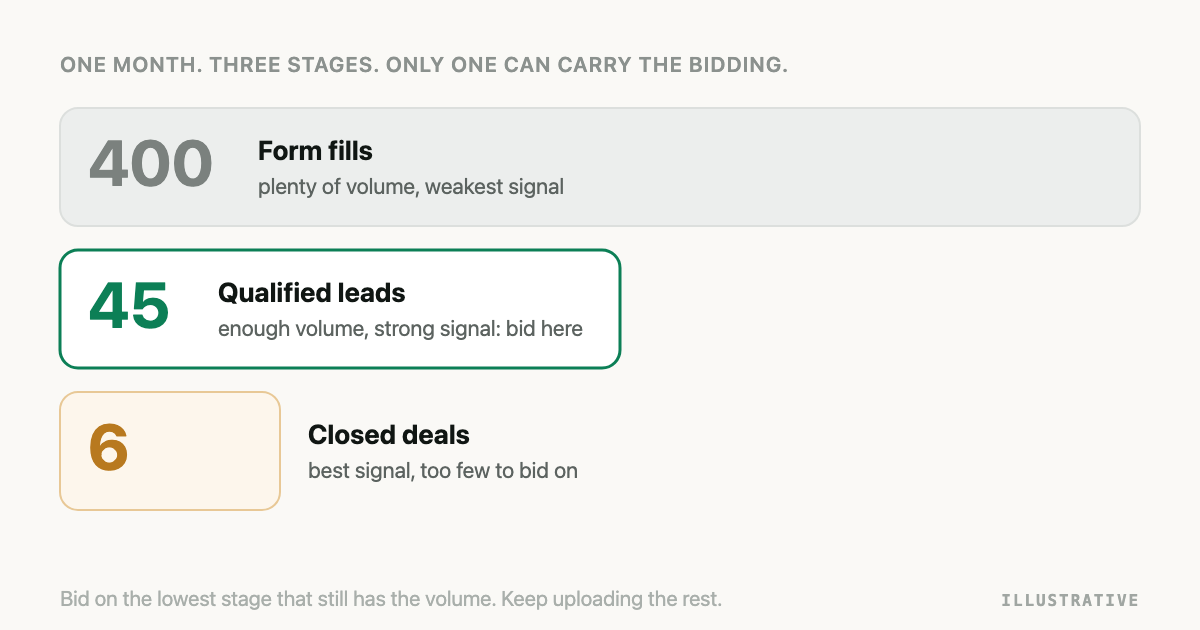
Everyone who runs lead gen ads reaches the same conclusion sooner or later: the campaigns should be bidding on closed deals, not form fills. So they connect the CRM, import the closed deals, switch the campaign goal, and watch spend fall off a cliff.
The idea was right. The jump was too big. A campaign that had 400 conversions a month to learn from now has 6. Automated bidding does not get smarter with a better signal it almost never sees. It gets starved.
The fix is unglamorous. Move the bid target down the funnel one step at a time, and only when the next step has enough volume to carry it. This article is about how to tell when that is, and what to change when you move.
How many conversions does automated bidding need?
Conversion volume for Smart Bidding is the number of conversions a campaign records in a recent window, which determines whether automated bidding has enough examples to learn from. Google recommends judging Target CPA over 30 days containing at least 30 conversions. Meta marks an ad set Learning limited when it is unlikely to get about 50 optimization events in a week.
Those are the two numbers worth memorising, and they come from the platforms themselves:
| Platform | What it says | Where it applies |
|---|---|---|
| Google Ads, Target CPA | Measure performance over the last 30 days, including at least 30 conversions | The campaign you are evaluating |
| Google Ads, Target ROAS on Search | At least 15 conversions in the past 30 days, and they must carry values | The conversion tracking level |
| Meta | About 50 optimization events in the week after the last significant edit, or the ad set becomes Learning limited | Each ad set |
Read them as floors, not as targets. A campaign sitting at exactly 30 conversions a month is technically workable and practically jumpy.
Notice also how different the two are. Thirty a month on Google is roughly one a day. Fifty a week per ad set on Meta is seven a day, for every ad set. A conversion that is comfortable on Google can be far too rare for Meta in the same account.
If you do not know your own numbers by stage, Attribi counts qualified leads and closed deals per ad account from your CRM, which is the count this decision needs.
The ladder
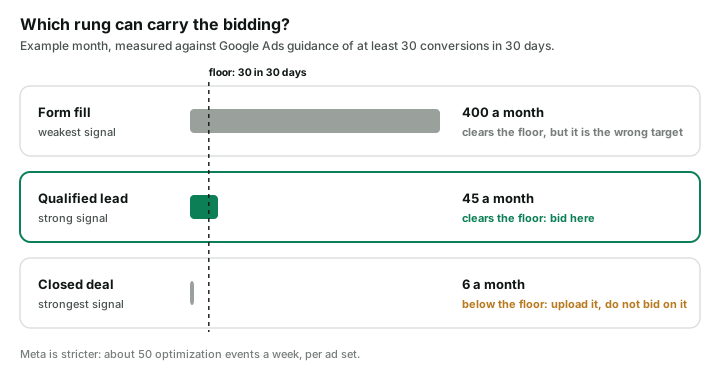
Think of your funnel as a ladder with three rungs.
Form fill. High volume, weak signal. Anyone can fill in a form, and the cheapest form fills come from the people least likely to buy.
Qualified lead. Your sales team spoke to them and confirmed the basics: reachable, real intent, a budget that fits. Lower volume, much better signal.
Closed deal. The actual goal. Best signal there is, and in most lead gen businesses, far too rare to bid on directly.
Take an illustrative account: 400 form fills a month, 45 qualified, 6 closed. On Google, the qualified rung clears 30 in 30 days with some room. The closed rung, at 6, clears nothing. So the right bid target today is qualified leads. Not because closed deals do not matter, but because six examples a month is not enough for a bidding system to tell a pattern from a coincidence.
The rule: bid on the lowest rung that still clears the threshold, and keep sending the rungs below it anyway.
That last part matters. You upload closed deals even while you bid on qualified leads. They show up in reporting, they carry revenue for your own ROAS numbers, and they build the history you will need when volume grows enough to move down again.
One thing I want to be straight about. Uploading qualified leads and closed deals does not change bidding by itself. It gives you a better conversion to point campaigns at. Bidding changes when you make that conversion the one campaigns optimize for. The upload is the precondition. The switch is the decision.
What to change when you move a rung
This is where most of the damage is done, and it is arithmetic, not strategy.
The cost target has to move with the conversion
Say your campaigns run a Target CPA of 40 dollars on form fills, and one form fill in nine becomes a qualified lead. A qualified lead therefore costs you about 360 dollars.
If you switch the campaign goal to qualified leads and leave the target at 40, you have just told Google to find 360 dollar outcomes for 40. It cannot. It stops bidding, impressions collapse, and the conclusion people draw is "optimizing on qualified leads does not work for us".
The new target is the old target multiplied by the ratio between the two stages. In this example, 40 times 9.
Scale each campaign, do not flatten them
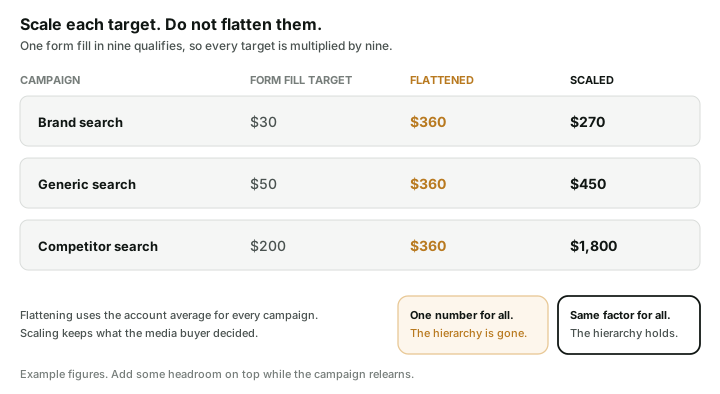
Accounts rarely have one target. Competitor search might run at 200, brand at 30, generic at 50, and those differences are deliberate. Somebody decided a competitor click was worth more.
If you compute one account-wide qualified lead cost and paste it into every campaign, you erase those decisions. Multiply each campaign's existing target by the same factor instead. The campaigns you bid high on stay proportionally high.
Leave room during the changeover
A campaign whose conversion goal just changed is relearning. Give it some slack: a target a little above the computed number, and no other edits for a couple of weeks. Changing the goal, the budget, the ads and the audiences in the same week makes it impossible to know what caused what.
Check the budget against the new target
If a campaign's daily budget is 100 dollars and its new target cost per conversion is 360, it cannot afford one conversion a day. Raise the budget or leave that campaign on the old goal.
Use the right month
Qualified leads lag form fills. If your sales team takes two weeks to qualify, then the leads from the last two weeks have mostly not been qualified yet. Divide this month's spend by this month's qualified count and the cost looks far worse than it is. Compare spend with the qualified leads that came from that same spend, which means looking back by your typical lag.
Meta works differently
Two things change on Meta.
The threshold is per ad set and per week, as covered above, so the same qualified volume spread over six ad sets may clear nothing. Consolidating ad sets is often the only way to get a lower-funnel event over the line.
And Meta treats a change of optimization event as a significant edit, which restarts the learning phase for that ad set. In practice, the clean way to move an ad set to a new event is to build a new ad set with that event and pause the old one, keeping the old one intact in case you need to go back.
When to climb again, and when not to
Check monthly. Volume moves with seasons, budgets and new campaigns, and an account that could not carry a closed-deal target in March may be able to in September.
And accept that some accounts never get there. If you close five deals a month and each is worth a lot, qualified leads may be your permanent bid target, with closed deals uploaded for reporting. That is a fine place to stay. It is still a long way better than bidding on form fills.
How Attribi handles this
Attribi has a feature for exactly this, called funnel graduation. I build Attribi, so here is the plain version of what it does and where it stops.
Attribi counts your qualified leads and closed deals from what your CRM confirmed, not from what the ad platform reports. It checks every day. When an account has enough qualified volume, it emails you a recommendation: which campaigns, and the suggested new target for each. By default that is around 30 qualified leads in 30 days, and it will not recommend anything below 20 qualified leads or 100 dollars of spend, because the arithmetic means nothing at that size.
The suggestion follows the rules above. Each campaign's target is scaled from its own current target, with a 15 percent buffer for the changeover. The spend window is shifted back by your account's typical time to qualify. If a campaign's daily budget is under twice its suggested target, Attribi blocks the change and tells you which budget to raise.
Nothing in your ad account changes until a person clicks Execute. If the account changed between the recommendation and the click, Attribi stops and shows the difference. For 14 days afterwards one click puts every campaign back as it was. It cannot give back money already spent.
The limits:
- It makes the change for you on Google Ads and Meta only. On LinkedIn, Microsoft, TikTok and Snapchat, Attribi uploads the stages and you make the switch yourself.
- Readiness is judged from outcomes that came from a Google Ads click. If Meta is the only place you advertise, you will not get a recommendation today.
- On Meta you will see two ad sets where you had one, the original paused and a new one beside it, for the reason given above.
There is more on the funnel graduation page. To see where your own account sits on the ladder, start a 30 day trial. It needs a CRM connection and a few weeks of leads before the counts mean anything.
Frequently asked questions
How many conversions do I need for Target CPA in Google Ads? Google recommends measuring Target CPA performance over the last 30 days with at least 30 conversions in that period. Campaigns can run on less, but results below that level are too noisy to judge.
What should I do if I do not have enough closed deals to optimize on? Bid on an earlier stage that happens more often, usually a qualified lead confirmed by your sales team, and keep uploading closed deals for reporting. Move the bid target to closed deals later if their monthly volume grows enough.
Why did my campaign stop spending after I changed the conversion goal? Usually because the cost target was not changed with it. A qualified lead costs several times more than a form fill, so a Target CPA set for form fills is far too low for the new goal and the campaign cannot win auctions.
How do I calculate a Target CPA for qualified leads? Multiply each campaign's current form fill target by the number of form fills it takes to produce one qualified lead. Use qualified leads matched to the spend that produced them, allowing for the time your team takes to qualify.
Does uploading offline conversions improve Smart Bidding automatically? No. Uploading gives Google a better conversion to work with, but bidding only changes when that conversion is set as the goal campaigns optimize toward, and when it has enough volume.
How many conversions does a Meta ad set need to leave the learning phase? Meta looks for about 50 optimization events in the week after the last significant edit. An ad set unlikely to reach that is marked Learning limited.
The takeaway
Closed deals are the right goal and usually the wrong bid target. Find the lowest rung of your funnel that still clears the platform's volume floor, bid there, scale every campaign's cost target by the same factor, and look again next month. It is slower than switching straight to revenue. It also works, which the other way mostly does not. If you would like the counting and the arithmetic done for you, try Attribi.