Offline Conversion Tracking Without a Website Pixel
By Rajesh Kumar, Founder, Attribi ·
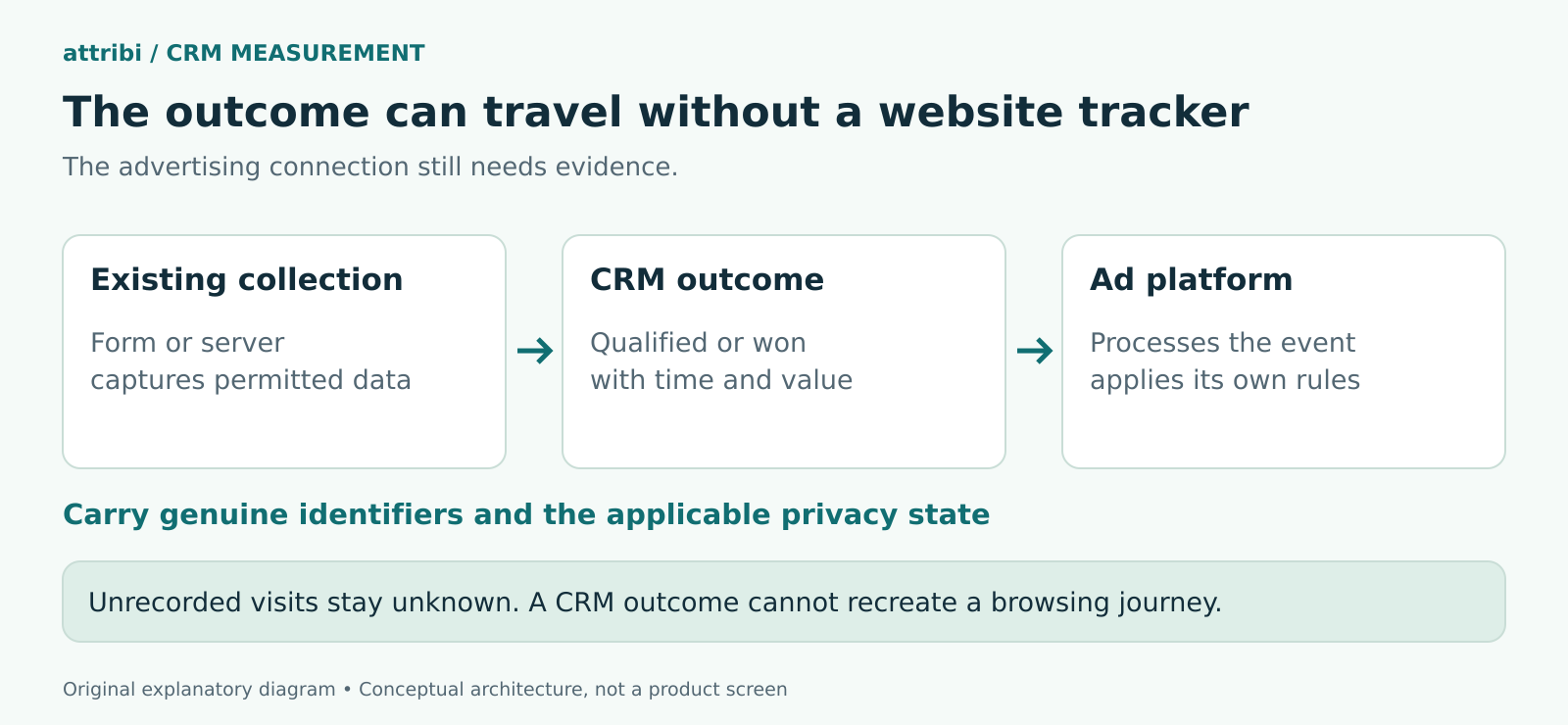
Your CRM can send qualified leads and won revenue to ad platforms without an Attribi website tracker. It still needs a supported way to connect those outcomes to advertising, such as a genuine click ID or permitted customer data. Removing a tracker does not recreate missing journeys, guarantee attribution or remove privacy obligations.
That distinction matters when a website release is months away, a security review blocks another script, or most sales happen through calls and a sales team. You may already have enough data to build a useful feedback loop. The right question is which outcomes and advertising connections your existing systems can actually support.
This guide explains what your CRM can and cannot tell ad platforms, how to choose a viable pixel-less route, and where a limited implementation needs a deliberate boundary.
What without a website pixel actually means
Three different architectures often share the same label.
Without the Attribi tracker. Your website may still use its existing form code, CRM tracking, a consent manager or advertising tags. Attribi receives CRM records and sends eligible downstream outcomes. This is the scope described in the pixel-less setup guide.
Without a browser advertising pixel. Your own form or server captures an available advertising identifier and stores it with the lead. That can reduce dependence on a particular browser tag, but collection still needs to happen somewhere. A server can read a parameter arriving in a request; it cannot recover a parameter that was stripped before that request arrived.
Without any usable advertising identifier or permitted customer data. Your CRM can still report sales, pipeline and recorded source labels. It cannot reliably tell an ad platform which advertising interaction belongs to an otherwise unidentifiable customer.
These distinctions change the project brief. A ban on adding third-party JavaScript is different from a ban on advertising measurement or data sharing. Ask the website owner what is restricted before designing a workaround. Moving collection into first-party code or a backend is an architectural choice that also needs approval under your organisation's policies.
Start with the outcome your CRM knows
The strongest contribution of a CRM is usually what happened after the enquiry. A form records interest. Sales records whether the prospect met qualification criteria, attended a consultation, signed an agreement or generated revenue.
Define one useful milestone in business language before mapping it to a platform event. For example, a qualified lead might require an accepted service area, a verified contact and a confirmed need. Closed-won might mean an executed contract with an agreed amount. Neither definition should depend on a salesperson choosing an attractive label.
Also decide what one conversion represents. Is it a contact's first qualification, each new opportunity, each first sale or every paid order? A contact can have multiple deals. Sending contact-level events cannot automatically provide transaction-level revenue reporting.
Keep three times separate: when the lead arrived, when the milestone occurred and when the integration sent the event. Using the upload time as the sale time changes the meaning of the data. A timezone should travel with the timestamp rather than being reconstructed from an export filename.
These are useful decisions even when no advertising platform can match a record. They improve the CRM's own reporting and prevent a measurement project from concealing a sales-process problem.
Choose between click IDs and customer matching
A genuine click ID preserves a specific connection
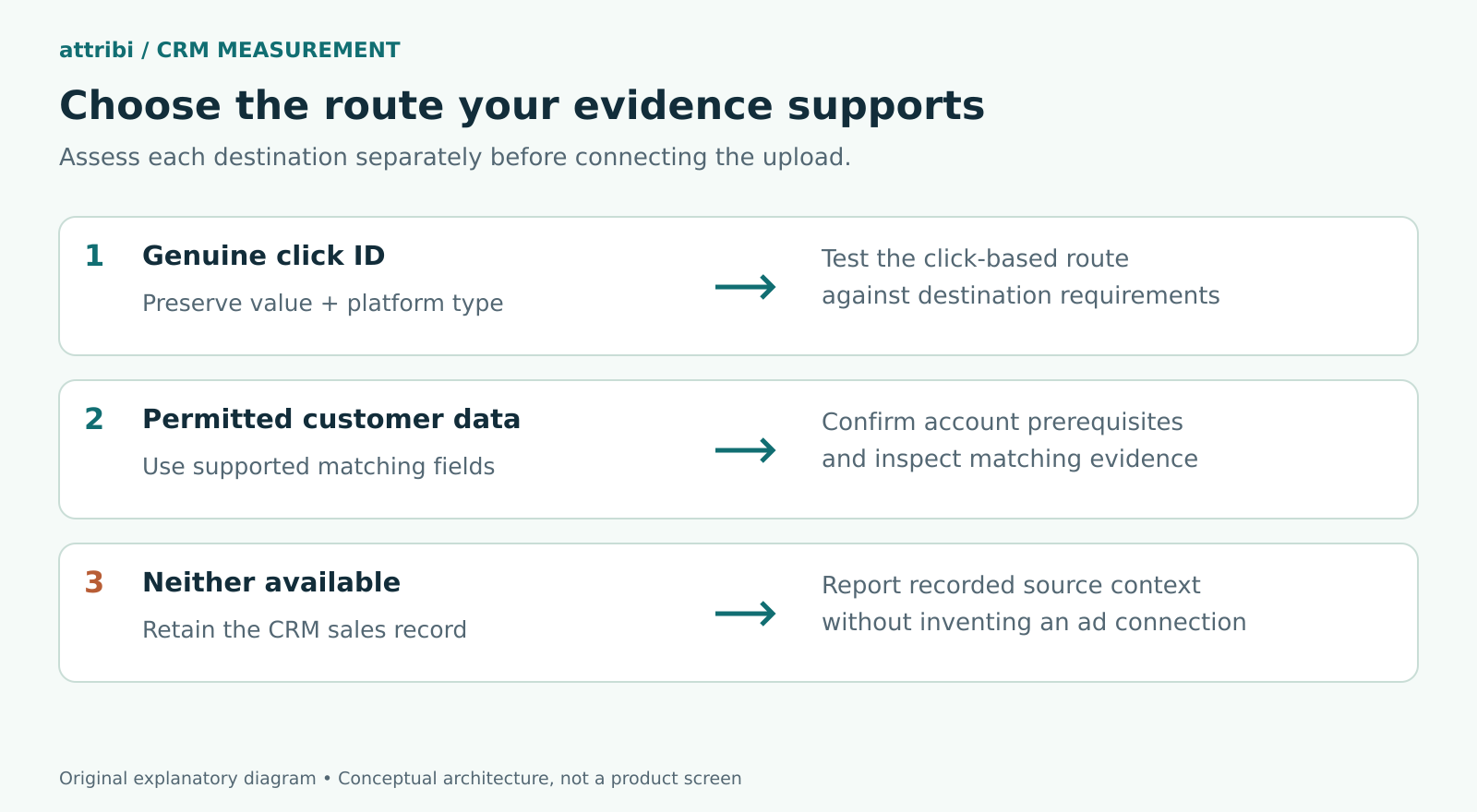
An advertising click ID is a platform-generated identifier attached to an eligible interaction. Preserve its original value and type. A GCLID, for example, belongs in the Google route; a LinkedIn click ID belongs in the LinkedIn route. A UTM campaign name provides descriptive context but does not substitute for either identifier.
Google's GCLID setup instructions describe enabling auto-tagging, capturing the identifier and storing it with the prospect. The practical issue is continuity: redirects, embedded forms, navigation and CRM field mapping must all preserve the association.
If your existing form already captures a genuine identifier, omitting an additional tracker may be realistic. If nothing captures it today, a CRM integration alone will not repair that gap. Review how to capture GCLID in your CRM before deciding the upload connector is the missing component.
Customer data supports a different matching route
Some platform workflows use permitted first-party customer information, such as an email address or phone number, to attempt a match. Availability depends on the platform, configuration, data quality and applicable policies. A work email that differs from the person's platform account may be less useful than expected.
Google's enhanced conversions upgrade guidance describes combining imported customer data with website and advertising signals. It specifically calls for GCLIDs when a tag is not collecting user-provided data. Do not turn the existence of an email field into a universal promise that every Google implementation works without tags or click IDs.
The Data Manager offline event schema supports multiple identifier inputs. Schema acceptance and the end-to-end measurement prerequisites are different checks. Confirm the supported route for the account rather than treating an optional API field as permission to omit every other signal.
For LinkedIn, the Conversions API schema describes supported user identifiers, including hashed email and its first-party advertising tracking UUID. This is another platform-specific mapping, not a reason to send one undifferentiated click-ID field to every destination.
Unsure which route your existing forms and CRM support? Book an Attribi demo and bring the fields you already capture, the platforms you use and the outcome you want to measure.
Build a small reliable CRM data contract
Treat the following as an implementation checklist, not a requirement to collect every possible identifier. Share only data that is necessary and permitted for the chosen destination.
- Record identity: a stable contact or lead ID, plus the relevant deal or transaction ID where your counting policy requires one.
- Milestone: a clear stage definition and the original time it occurred, including timezone.
- Financial value: the approved revenue field and currency, with a written rule for missing amounts, cancellations and repeat sales.
- Advertising evidence: the genuine click ID, its platform type and when or where it was captured, if available.
- Matching information: supported customer fields with documented provenance and permitted use.
- Privacy state: applicable consent or permission evidence, collection notice version and any suppression instruction your workflow must honour.
Keep source descriptions separately. A salesperson's "Google" selection, a UTM campaign and a platform click ID serve different purposes. Combining them into one field makes it difficult to distinguish an observed identifier from a reported source.
Check whether the integration reads contact properties, deal properties or an association between them. A value that looks correct on a contact screen may be absent from the object the connector reads. Also check whether updates are reread or whether the mapping is used only when a person is first imported.
Normalisation needs an owner. Platform-specific formatting may require trimming and lowercasing email or converting telephone numbers into an international format before hashing. Do this according to the destination's specification. Hashing an incorrectly formatted value simply makes the incorrect value harder to inspect.
Finally, record the provenance of a click ID without silently overwriting history. If your chosen implementation keeps only the latest captured value, document that rule. It is a single retained association, not evidence that the latest click caused the sale.
What Attribi can represent in CRM only mode
Attribi's pixel-less attribution feature describes a CRM-based route for qualified and won outcomes without its website tracker. The documented representation creates a single CRM-derived touch rather than collecting anonymous pageviews or reconstructing a full multi-touch journey.
That makes the mode useful when downstream outcomes already exist and a tracker deployment is blocked. It also defines the reporting boundary. A CRM-derived touch does not reveal every research visit, an earlier channel exposure or an unrecorded return visit.
For HubSpot, examine the integration's current behaviour before assuming any populated field will be picked up. Its documentation says both the click-ID and type properties are needed, and that click-ID reading occurs from the contact when Attribi first imports that person from a deal. An existing imported lead may therefore need investigation rather than an assumption that a later field update repairs its attribution.
The same documentation describes once-per-contact stage behaviour, excludes a second won deal from another won upload, and requires an amount for revenue upload. These limits matter if your business sells repeat services or maintains several opportunities for one buyer.
The Google Ads integration page describes direct Data Manager uploads. That removes a GA4 or GTM dependency from the upload step; it does not establish that your entire collection and matching setup needs no website changes. Confirm the current CRM read schedule and destination prerequisites during implementation.
A fictional HubSpot example
The following business, records and amounts are invented to illustrate the design. They are not customer results or performance benchmarks.
Harbour Engineering sells services in the UK and uses HubSpot. Its website team cannot add the Attribi tracker this quarter, but an approved form integration already captures genuine Google click IDs and sends them into the agreed HubSpot contact properties.
A prospect submits an enquiry. The record contains a stable contact ID, an associated deal, an actual GCLID, its type, the enquiry time and the relevant permission evidence. Sales qualifies the opportunity two days later. The business has agreed that qualification means a verified project and a serviceable location.
Three weeks later, the deal becomes won for GBP 8,000. The integration can use the documented qualified and won workflow, subject to its field mapping, supported event timing and platform configuration. The original milestone times remain attached to their respective events; the team does not replace them with the next sync time.
Consider three variants of that record:
- The click ID and type were present at initial import. There is a plausible click-based route to test. The team still checks whether the platform processed and attributed the outcome.
- The click ID was added after the person already existed in Attribi. The team checks the integration's initial-import limitation before claiming that the new field repaired the record.
- The form saved only a UTM campaign name. The CRM can report the recorded campaign label, but this does not create a Google click ID. Any customer-matching route needs its own verified prerequisites.
Suppose the same contact later buys another GBP 2,000 service. HubSpot's total recorded sales are now GBP 10,000. Under the documented once-per-contact won behaviour, the team must not assume that the second deal becomes a second won upload. CRM totals and platform event totals have different scopes.
The decision is therefore specific: use CRM-only measurement for the supported first qualification and first won outcome, while retaining the CRM's transaction-level reporting for all sales. If repeat-purchase optimisation is required, confirm a suitable supported design before launch.
Want to check that your CRM's counting rules fit the integration? Book a demo with Attribi using one anonymised example of a first sale and a repeat sale.
Read delivery attribution and lift separately
A working upload answers a transport question. It does not answer every marketing question.
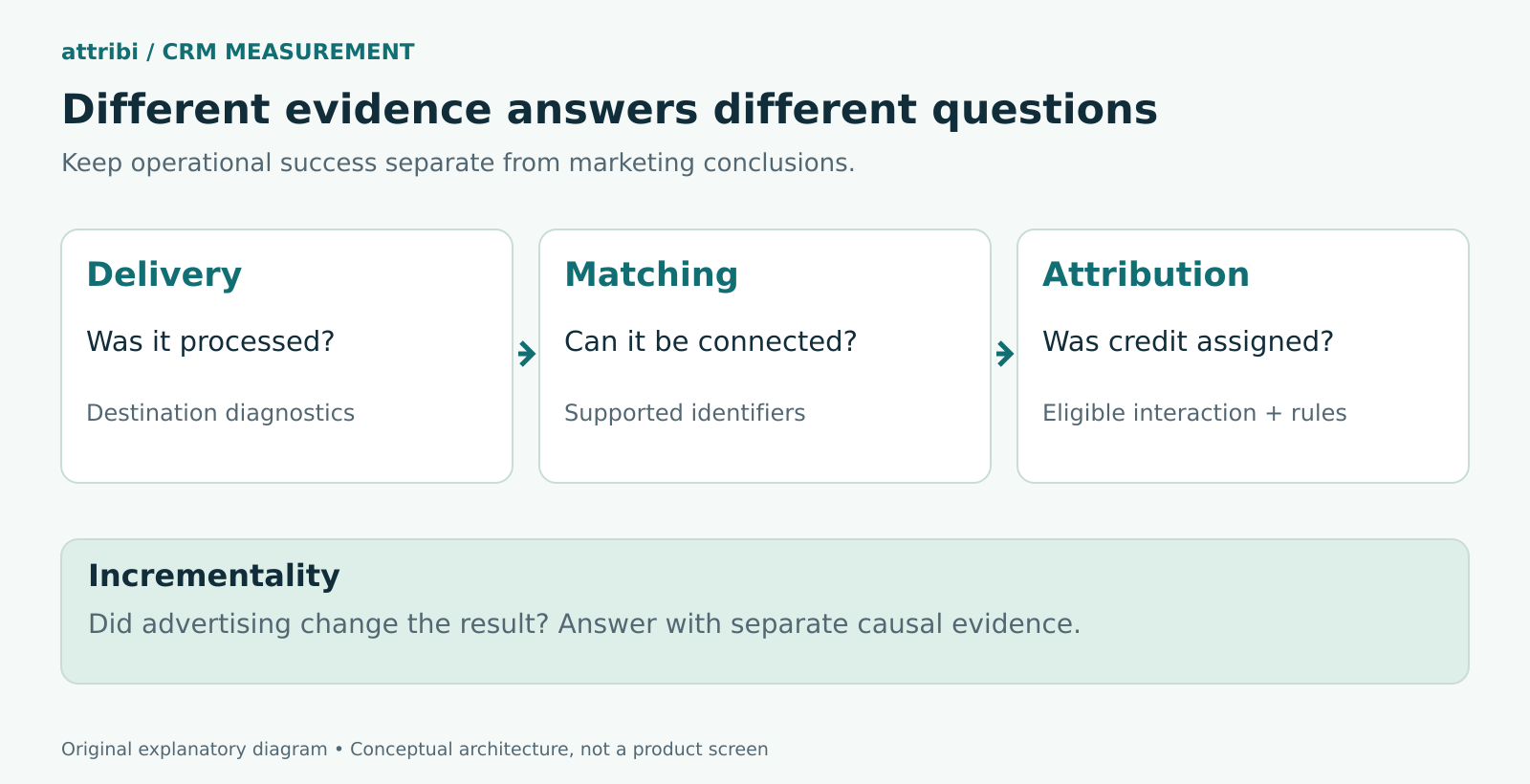
Delivery asks whether the destination received and processed the event. Matching asks whether the available identifiers supported an association. Attribution asks whether an eligible advertising interaction received credit under the platform's rules and window. Incrementality asks whether advertising changed the outcome compared with what would otherwise have happened.
The distinction is especially important in a pixel-less setup because the CRM may have a complete sales record while the observable advertising history is incomplete. A successful delivery can coexist with no reported campaign credit. Conversely, attributed revenue does not establish that every credited sale would disappear without advertising.
Use separate labels in reporting. "CRM won revenue", "events accepted" and "platform-attributed revenue" should not be presented as interchangeable totals. If a platform does not expose individual matching outcomes, label that status unknown rather than calculating a match rate from the difference between uploads and attributed conversions.
For causal questions, plan an appropriate controlled experiment or another defensible incrementality method. Changing the attribution model applied to the same incomplete journey cannot supply a missing counterfactual.
Privacy obligations travel with the data
Removing a browser tracker does not make customer matching anonymous. The purpose of a matching identifier is to connect records relating to someone. The ICO's pseudonymisation guidance explains the role and limitations of hashing and other pseudonymisation techniques.
For UK and European operations, have the appropriate privacy owner assess the lawful basis, notices, consent requirements where applicable, retention, transfers and contracts for the actual data flow. For US operations, review applicable state requirements and platform restrictions. A server-side implementation is not a compliance certification.
Google's customer data policies include disclosure and consent obligations where required. Record the customer's actual choices rather than assigning a blanket "granted" state so a payload passes validation. Technical permission to send a field is different from permission to use it for advertising.
Also distinguish what goes to the advertising platform from what an intermediary stores. Attribi's privacy feature documentation describes hashing for platform transmission alongside storage of raw email and phone data. Review that architecture against your requirements; do not promise stakeholders that raw identifiers never leave the CRM.
Validate the boundary before scaling
Start with a permitted test that checks field transport, then separately validate an eligible genuine advertising interaction. A made-up GCLID can demonstrate that a string survives a form submission. It cannot demonstrate that Google recognises an ad click or attributes a conversion.
Check one outcome through the whole route: source record, property mapping, import behaviour, destination event and subsequent reporting. Allow for the actual integration schedule and platform processing delay. Investigate missing evidence at the stage where it disappears instead of repeatedly changing the CRM record.
Before using a new outcome for automated bidding, confirm that its definition, value, volume and delay are appropriate for the campaign. Avoid accidentally counting both a lead and its downstream sale as equivalent business outcomes. The more detailed CRM offline conversion tracking QA guide covers operational validation after the architecture is chosen.
Frequently asked questions
Can I track offline conversions with no website changes?
Sometimes, if an existing permitted collection process already provides the identifiers and CRM fields your chosen route needs. If those inputs are absent, connecting the CRM does not create them. Confirm the requirements for each destination.
Can I upload conversions without a GCLID?
Some workflows accept other supported identifiers or customer data. That does not guarantee attribution or remove configuration requirements. For Google, review the enhanced-conversion guidance and the actual account setup before relying on a customer-data-only route.
Will pixel-less tracking recover every lost conversion?
No. Missing identifiers, unsupported milestones, timing limits, privacy choices and unmatched records can still limit measurement. CRM-only mode also cannot reconstruct website visits that were never observed.
Does hashing remove the need for consent?
No. Hashing changes a data representation. The required permissions and legal assessment depend on the processing, jurisdiction and platform rules. Treat hashing as part of data handling, not a universal exemption.
When should I add the Attribi tracker later?
Consider it when you need observed website activity and richer journey analysis beyond the CRM-derived touch. Review collection permissions and implementation requirements first. Adding tracking later cannot recreate historical visits that were never captured.
Build the feedback loop your data can support. Book an Attribi demo to review a pixel-less starting point and identify the evidence you would need for deeper attribution later.